The Life — How to
How to make matcha: the numbers, then the hand
A bowl of matcha is three measurements and one motion. Two grams of powder, sixty to seventy milliliters of water at seventy to eighty degrees, and a whisk moved fast through the middle of the bowl for about fifteen seconds. Everything else — the tools, the foam, the thick tea, the latte, the iced glass, the days you have no whisk — follows from those.
This Matcha Life is reader-supported. When you buy through links on this site we may earn a commission, at no extra cost to you. We choose what to cover before we look at what it pays. This page contains no affiliate links.
In short
- Standard bowl: 2 g sifted, 60–70 ml water at 70–80°C, whisked fast in a W for about 15 seconds.
- Koicha is 4 g kneaded with about 30–40 ml; a latte is a 2 g paste in 30 ml water, then milk.
- Most bad bowls have one of five causes: hot water, too much powder, a cooking-grade tin, an old tin, no sifting.
How do you make matcha? The short answer
Sift 2 g of matcha into a wide bowl. Add 60–70 ml of water heated to about 70–80°C (160–175°F). Whisk briskly in a W or M pattern with the tines just off the bottom for about fifteen seconds, until the surface is a fine, even foam. Lift the whisk gently through the middle. Drink.
That is usucha, “thin tea,” the bowl most people mean when they say matcha. The numbers are the ones Japanese tea houses print on the tin, and they are worth following exactly the first ten times; after that your hand knows them, and you can begin to move them. Ippodo’s own recipe page, for one, gives 2 g, 60 ml of water at 80°C and fifteen seconds of whisking.
This page goes through every part of that sentence — the tools, the water, the motion — and then through the other things you can make with the same 2 g: the thick tea, the latte hot and cold, the shaken glass, and the drink you make on the morning the whisk is nowhere to be found. At the end is a troubleshooting table for the bowls that go wrong, because nearly every bad bowl has one of five causes.
What you need
None of this is expensive and all of it can be substituted for a while. In rough order of how much difference each makes:
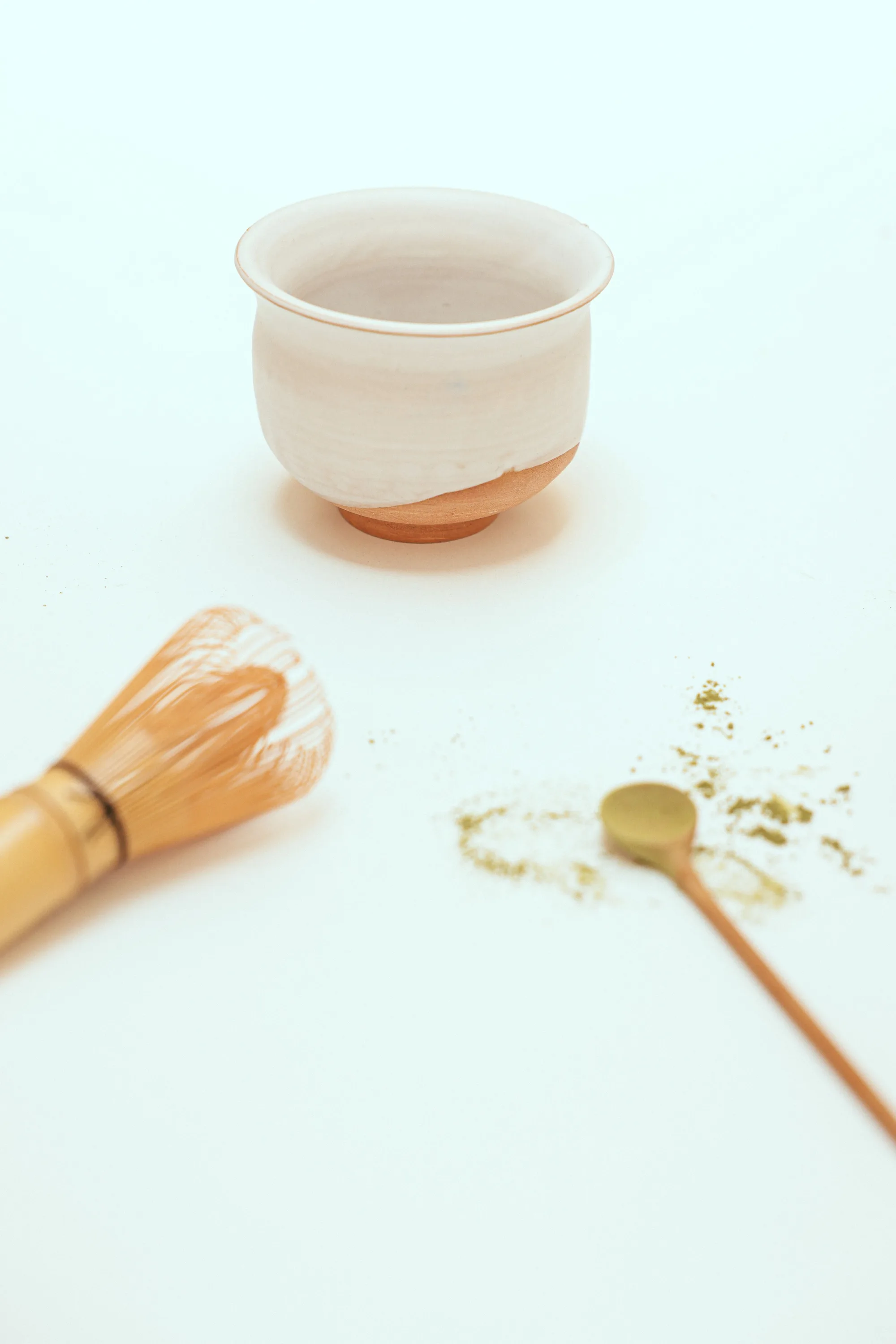
A bowl (chawan). Wide and low, so the whisk can move side to side without hitting the walls, and heavy enough to sit still in one hand. Japanese tea bowls come in shapes for the season — taller, narrower “winter” bowls that keep tea hot, and shallow, open “summer” bowls that cool it — but for a kitchen the working rule is simple: an opening about the width of your palm and a flattish bottom. A wide cereal bowl works while you decide whether you want a proper one. A mug does not; the whisk cannot move in it.
A bamboo whisk (chasen). About 100 tines is the everyday standard, and the tool the whole method assumes. The tines are split from a single piece of bamboo, thinned to hair-fine tips and curled inward, and it is their thinness and number that fold air into the water and turn it to foam. Before every use, stand the tines in warm water for a minute so the bamboo softens and the curled tips relax; dry bamboo snaps. Most whisks sold in Japan and abroad are imported and unlabeled; the ones made in Takayama, Nara, from aged bamboo, cost more and last longer, and the number of tines is printed on both.
A small sieve. Matcha is milled to a few microns and clumps from static and humidity. Sifting is the difference between a smooth bowl and green specks that burst bitter on the tongue. A fine tea strainer held over the bowl is enough; push the powder through with the scoop or a spoon.
A scoop, or a scale. The traditional measure is the chashaku, a curved bamboo scoop that holds roughly a gram in its tip, so two scoops make a bowl. It is approximate — a third either way depending on the scoop and your hand. A level teaspoon holds roughly 2 g, depending on how the powder is packed. A pocket scale that reads to a tenth of a gram removes the argument, and a week with one teaches your scoop hand what two grams looks like.
A kettle with temperature control, or patience. Water off the boil, poured into a cup or the empty bowl and left for two to three minutes, lands near 75–80°C. A variable-temperature kettle set to 75°C skips the waiting and is the one appliance that earns its place if you make a bowl every day.
A whisk stand (kusenaoshi). Optional on day one, not optional by day thirty. The ceramic bell-shaped stand holds the whisk tines-up and open so it dries through the center, which is what prevents mold and keeps the shape.
The water
Three things about the water matter, and temperature matters most.
Temperature. Seventy to eighty degrees is the working range for usucha. Above it, the bowl tastes sharper and the foam collapses quickly; below about 65°C the foam is slow to form and the tea tastes flat and thin. If you must err, err cool. Koicha, the thick tea, is often made a little hotter because the paste cools fast and there is so little water; the lower end of the range still works.
Hitting the temperature without a thermometer. Bring the kettle to a boil, pour the water into a cup or the bowl itself, and wait. In a ceramic cup at room temperature, boiled water drops to about 80°C in two to three minutes. Pouring it once more between two cups drops it faster. Or add a splash of cold water to freshly boiled water — roughly one part cold to four parts boiled gets you close. After a few days you will judge it by the steam.
Quality. Matcha is mostly water, and water with a strong taste of chlorine or minerals shows. Filtered tap water is fine. Very hard water tends to flatten the foam and dull the taste; very soft water makes a softer, sweeter cup, which is one reason the same tin tastes different in different cities.
Pre-warming the bowl. Pour a little hot water into the empty bowl, swirl, and tip it out before you add the powder. A warm bowl keeps the tea at temperature through the whisking and gives the whisk a moment in the water. Tea schools do this in front of the guest; at home it takes ten seconds and improves every bowl.
Usucha, step by step
- Warm the bowl. Hot water in, swirl, out. Wipe the inside with a cloth if it is wet; a puddle in the bottom dilutes the first bowl.
- Soak the whisk. While the bowl warms, stand the whisk tines-down in the hot water for a minute. Shake it off.
- Sift 2 g of matcha into the bowl. Hold the strainer over the bowl and push the powder through. It will fall as a soft mound.
- Add a splash of water and make a paste. This is optional and it is the step that saves most beginners. A tablespoon of your 70–80°C water, worked into the powder with the whisk for a few seconds, dissolves any remaining clumps before the foam stage.
- Add the rest of the water. Sixty to seventy milliliters in total. A standard espresso cup holds about 60 ml if you need a measure.
- Whisk. Fifteen seconds, described in detail below.
- Finish and drink. Slow down, draw the whisk once around the edge to gather large bubbles, lift it out through the center so a small peak forms. Drink from the bowl in two hands, in a few sips, while the foam is still standing.
The whole thing takes about ninety seconds once the water is at temperature, and most of that is whisking.
The motion
Hold the bowl with one hand, low around its side, so it cannot slide. Hold the whisk like a pen, lightly, between thumb and first two fingers, not gripped like a hammer. The movement is from the wrist, not the arm: back and forth across the middle of the bowl, fast — a W, then an M, then a W — with the tips of the tines just off the bottom so they do not scrape. You should hear the tines hiss through the water. You are not stirring in circles; circles push the powder to the rim and leave the center thin. You are aerating the middle, and the foam builds from there outward.
After eight to ten seconds the surface changes from dark and wet to a pale, tight foam with tiny bubbles. Keep going a few seconds more. Then slow down, move the whisk once around the edge of the bowl to pull the large bubbles into the center where they will break, and lift the whisk straight up through the middle. A good bowl has a fine, even foam across the whole surface and a small peak in the center where the whisk left.
Two common faults have easy signatures. If the foam will not form, the water is too cool, the bowl is too narrow for the whisk, the powder was not sifted, or you are moving too slowly — speed is what folds the air in. If the foam forms and collapses at once, the water was too hot.
Different tea schools whisk to different foams — some prefer a thick, creamy layer, some a thin one with the tea showing through — and neither is wrong. At home, the foam you like is the right one.
Koicha: the thick tea
Koicha is the same leaf at twice the powder and about half the water: 4 g of matcha with just enough hot water to make a glossy, slowly pouring paste, somewhere around 30–40 ml. It is not whisked to foam. It is kneaded — the whisk moved slowly and deliberately through the powder and water until the paste is smooth, thick and bright, with no foam at all.
The method: warm the bowl thoroughly, because there is so little liquid that it cools fast. Sift 4 g. Add about half the water and knead with the whisk in slow strokes until the powder is fully wet and the paste is even. Add the rest of the water a little at a time, kneading, until the consistency is that of thin honey and the surface shines. Stop. Drink it in three or four sips.
Because nothing is diluted, koicha exposes everything in the powder — bitterness, astringency, any roughness in the leaf — which is why Japanese houses tag only their upper blends as suitable for it; Marukyu Koyamaen, for one, lists eleven standard blends and tags six for koicha. Make it with a powder the maker sells for thick tea, or with the best thin-tea powder you have, and expect a taste closer to a rich broth than to tea. It is the preparation that shows what the fuss about shading is for.
The latte
The latte is not a lesser bowl. It is a different one, and it has its own rule: make the tea first, then add the milk.
Sift 2 g of matcha into a cup or small bowl. Add about 30 ml of hot water — 70–80°C as before — and whisk into a smooth, strong paste with no clumps. Then pour in 150–200 ml of hot milk, steamed or simply heated, and stir. That is a hot latte. The order matters because powder mixed directly into milk clumps: milk fat coats the particles and water cannot reach them. Paste first, always.
Sweeten if you like — a teaspoon of sugar, honey or syrup stirred into the paste before the milk — but taste it plain first, because milk supplies most of the softness on its own. The powder decides the rest. A tin made for drinking straight will taste thin and vanish behind the milk; a bolder, slightly more bitter thin-tea blend, or a powder the maker explicitly sells for lattes, keeps its shape. Cooking-grade powders work in milk and taste sharp; koicha blends are wasted in it.
Milk. Whole dairy milk foams best and tastes roundest. Oat milk is the plant milk that holds up most reliably and foams well; almond is thin; soy varies by brand. If you froth the milk, do it before you pour, not after.
Iced latte. Same paste — 2 g and 30 ml of hot water, or cold water whisked harder — poured over a glass of ice, then cold milk on top. Do not stir until you have looked at it; the green over white is half the pleasure. For a large café-style glass, 3–4 g of powder in 40 ml of water keeps the taste from thinning.
Shaken iced matcha, no milk
This is the summer drink, and it needs no whisk. Put 2 g of matcha and about 200 ml of cold water in a jar with a tight lid, add a few ice cubes if you like, and shake hard for twenty seconds. Pour. The result is a pale, lightly foamed, refreshing glass with far less bitterness than a hot bowl, because cold water extracts less of the sharp compounds. A pinch of sugar or a squeeze of citrus goes well with it; so does nothing.
Some Japanese houses sell blends specifically for cold whisking — Marukyu Koyamaen lists two “mizutate” powders — and they foam better cold than a standard blend does. If you make this often, they are worth finding.
Without a whisk
The morning will come. Three substitutes, each a complete drink rather than a compromise:
- A handheld milk frother. Powder and a splash of water in a cup, frother in, thirty seconds. It makes a foam, though a coarser one than bamboo, and it is the best of the three for a latte.
- A shaker or jar. As above, hot or cold. Better cold.
- A blender. For iced drinks and smoothies. Powder goes in with the liquid, not on top of ice.
None of these makes a proper usucha foam, and a metal frother in a ceramic bowl will scratch it in time. But none of them stops you drinking good matcha, and that is the point.
Serving, if you want to
A bowl of usucha in Japan comes with a sweet, eaten before the tea, not with it. The sweetness sits on the tongue and the tea’s bitterness meets it; the two make sense together in a way neither does alone. A piece of good chocolate, a dried fruit, a small cookie — anything sweet and not too rich does the job. Drink from the bowl held in two hands, in three or four sips. If there are guests, the foam side of the bowl faces them and the bowl is turned before drinking; at home, none of that is required.
Cleaning up
Rinse the whisk under warm running water and whisk it briefly in a bowl of clean water to clear the powder from the center. Shake it off and stand it tines-up on the stand to dry. No soap, no dishwasher, no drawer while it is damp. Rinse the bowl. Reseal the tin — matcha fades within weeks of opening, and Japanese sellers generally advise finishing an opened tin within about two weeks to a month — and put it back in the dark.
Which powder for which bowl
The recipe is the same across tins; the tin decides the taste.
| Bowl | Powder | Why |
|---|---|---|
| Usucha | A blend the maker sells for thin tea, first harvest | Sweet enough to drink plain; foams well |
| Koicha | A blend the maker tags for koicha | Holds up undiluted; smooth, deep umami |
| Hot latte | A bolder thin-tea blend, or a latte-designated powder | Keeps its shape behind milk |
| Iced, shaken | Any thin-tea blend; cold-whisk blends if you find them | Cold water softens bitterness anyway |
| Baking | A cooking or processing powder | Milled for it; sharper flavor survives butter and sugar |
"Ceremonial" and "culinary" are not grades; they are English-market labels. Japanese makers state the use — koicha, usucha, cooking — and that is the word to look for.
Troubleshooting
| Symptom | Likely cause | Fix |
|---|---|---|
| Harsh, drying bitterness | Water too hot | Wait two to three minutes after boiling; aim for 70–80°C |
| Bitter and thick | Too much powder for the water | 2 g to 60–70 ml; measure once with a scale |
| Sharp, thin, grassy | Cooking-grade powder whisked plain | Use a thin-tea blend; keep the cooking tin for baking |
| Flat, hay-like, dull color | Old or light-exposed tin | Buy small tins; finish within a month; store dark and sealed |
| Green specks, gritty bites | Not sifted | Sift every time; make a paste first |
| No foam | Water too cool, bowl too narrow, whisking too slow | Warm the bowl; use a wide bowl; whisk fast from the wrist |
| Foam collapses at once | Water too hot | Cooler water |
| Whisk tines snapping | Dry bamboo | Soak tines in warm water a minute before use |
| Latte clumps | Powder added to milk | Paste with water first, then milk |
Three things that change the bowl more than the recipe
Freshness. An opened tin fades in weeks, not months. Chlorophyll breaks down under light and the powder browns and loses its aroma; humidity clumps it; air dulls it. Buy the size you will drink — the 20 g and 40 g tins the Kyoto houses have kept selling through the shortage are two to four weeks of daily bowls — and keep the tin sealed, cold and dark. Let a refrigerated tin come to room temperature before opening it, or condensation forms on the powder.
Temperature. Every ten degrees of water temperature is audible in the bowl. Too hot pulls bitterness forward; too cool leaves the foam flat. Seventy to eighty is the working range, and lower is the safer error.
The powder’s intended use. A tin milled for cooking is milled from later, less shaded leaf and will taste sharp whisked plain. That is not a fault in your hand. Match the powder to the bowl you are making, and the recipe above does the rest.
The first week
Make the same bowl every morning for a week: 2 g, 65 ml, 75°C, fifteen seconds. Change nothing. By the end of it your hand will know the motion, your eye will know the foam, and your tongue will know what the tin tastes like when nothing has gone wrong. Then change one thing at a time — a degree of temperature, half a gram of powder, a different tin — and you will be able to taste what each one does. That is the whole method, and it is how it has been taught for five hundred years.
Sources
- Marukyu Koyamaen — official site — Marukyu Koyamaen
- Basic Usucha (Matcha) — Preparing Tea — Ippodo Tea
Questions people actually ask
Do I need a bamboo whisk to make matcha?
For the classic foamed bowl, yes — the bamboo whisk (chasen) is the one tool with no real substitute, because its fine tines break up clumps and build foam without scratching the bowl. For a latte, a shaken iced matcha or a blended drink, a handheld milk frother, a shaker jar or a blender works and the result is a different but complete drink.
Why is my matcha bitter?
The usual causes, in order: water too hot, too much powder for the water, a powder milled for cooking rather than drinking, or a tin that has been open too long. Try 70°C water and 2 g first; that fixes most bowls. If it is still harsh, the powder is the problem, not your hand.
Can I make matcha with cold water?
Yes. Cold-whisked usucha is a recognized preparation in Japan, and some houses sell blends made for it. Sift, add cold water, whisk or shake harder than you would hot — foam forms more slowly in cold water — and expect a lighter, sweeter cup with less bitterness.
What is the ratio of matcha to water?
For thin tea, 2 g to 60–70 ml, which is roughly one part powder to thirty parts water by weight. For thick tea, 4 g to about 30–40 ml, closer to one to ten. For a latte, 2 g to 30 ml of water, then 150–200 ml of milk.
How hot should the water be for matcha?
About 70–80°C (160–175°F). Water straight off the boil pulls bitterness forward and flattens the foam. If you have no thermometer, pour boiled water into a cup or the bowl itself and wait two to three minutes; it lands near 80°C.
Why does my matcha clump?
Static and humidity. Matcha is milled to a few microns and the particles cling to each other. Sift it through a fine strainer into the bowl every time, and store the tin sealed and away from moisture. If clumps survive sifting, make a paste with a splash of water first, then add the rest.
Can I make matcha in a mug?
You can, but a mug is narrow and the whisk cannot move, so the foam will be poor and the tines will bend. A wide cereal bowl is a better stand-in than a mug until you have a chawan.
How many times a day can I make matcha?
As many as suit you; each 2 g bowl carries caffeine in the range of a cup of coffee, so most people find one or two bowls a day is their natural number. Sensitivity varies from person to person.
Read next