The Matcha — What it is
What matcha is made of
Matcha has one ingredient. It is the leaf of Camellia sinensis, the same plant behind every green, black and oolong tea, taken through four steps that no other tea gets in the same combination: weeks of shade, steaming, drying without rolling, and grinding to a powder fine enough to drink whole. Nothing is added. What changes is the leaf, and this page follows it from the field to the bowl.
This Matcha Life is reader-supported. When you buy through links on this site we may earn a commission, at no extra cost to you. We choose what to cover before we look at what it pays. This page contains no affiliate links.
In short
- Matcha is tencha — shaded, steamed, unrolled, destemmed tea leaf — ground to a powder of 5–20 microns. Nothing is added.
- A 2 g bowl carries about 64 mg caffeine, 20–45 mg L-theanine and about 200 mg catechins (MEXT tables and Japanese research).
- No law defines matcha in Japan, the US or the EU; ground sencha and sweetened mixes are sold under the name.
What is matcha made of? The short answer
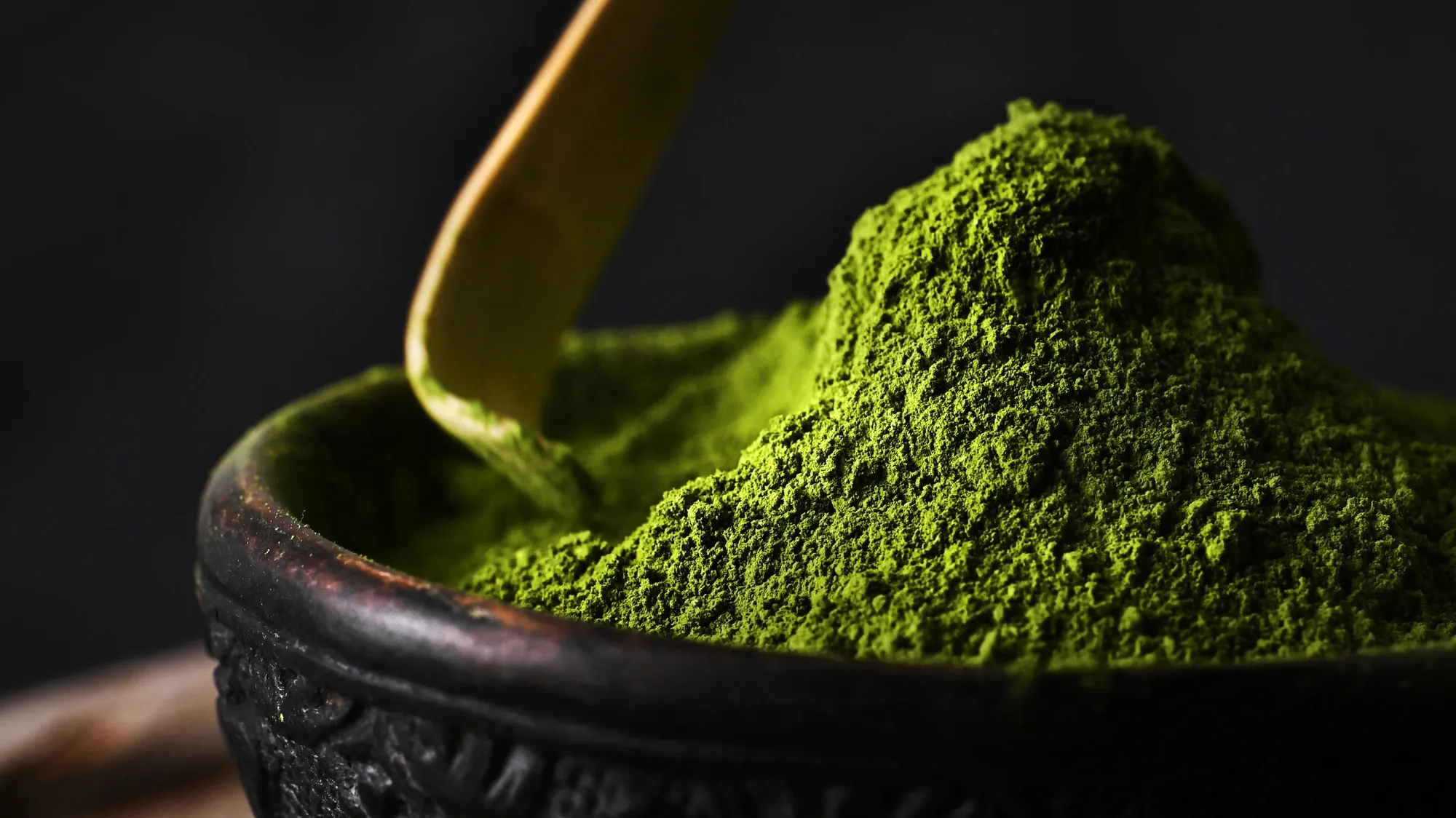
Matcha is tencha — shade-grown, steamed, unrolled tea leaf with the stems and veins removed — ground into a powder. The only ingredient is the leaf. The shading, the lack of rolling, and the grinding are what separate it from every other green tea, and each of those steps changes what is in the powder and what you taste.
What follows is the whole route, in the order the leaf takes it: plant, shade, harvest, steam, furnace, sieve, blend, mill. Then what is in the resulting 2 g, what is sold as matcha but is not, and why, for a product this specific, no government defines it.
Step one: the plant
Matcha begins as the ordinary tea plant, Camellia sinensis, the same species as black tea, oolong and sencha. Japanese tea is the small-leaf variety, grown as waist-high hedges in rows that present a flat surface of young shoots to the picker and, just as important, can be covered.
Within the species, the cultivar matters more for matcha than for any other tea. Yabukita, the cultivar behind about three-quarters of all Japanese tea, is a poor fit for shade: its covered leaf turns yellowish. Kyoto still grows it for about half its tencha acreage, but the district’s reputation rests on cultivars chosen for shading — Samidori, the most planted for hand-picked tencha; Asahi, which trades highest and is notoriously hard to grow; Gokou, Ujihikari and Okumidori — most of them selected in and around Uji since the prefecture’s research station began systematic selection in 1939. Kagoshima, now the largest tencha producer, grows Saemidori and others at scale. A newly planted field yields nothing usable for about five years, which is the first reason matcha cannot be made quickly.
Step two: the shade
For the three to four weeks before the spring harvest the rows are covered. The standard today is black synthetic cloth at roughly 85% shade, hung on frames above the hedges; the oldest fields in Uji still use honzu canopies of reeds and rice straw, which give the best leaf and the most labor. Kyoto’s research station puts the timing at about ten to fifteen days for lightly shaded teas and twenty days or more for gyokuro and tencha, beginning when the new shoots have opened two and a half to three leaves.
Under the cover the plant changes what it makes, and the changes are measured. It stops converting L-theanine — the amino acid it produces in the roots — into catechins in the leaf, so the leaf keeps its theanine, which is umami and sweetness, and makes fewer catechins, which are bitterness and astringency. It produces more chlorophyll, straining for light, which is the color. And it produces a sulfur compound, dimethyl sulfide, that gives shaded teas their marine, nori-like aroma — what Japanese tasters call the cover aroma. Caffeine rises somewhat under shade as well. Soil analysis in old Uji tea gardens suggests the practice began in the early fifteenth century, earlier than the sixteenth-century missionary accounts that were long its first written record.
Shading is expensive: it cuts yield, weakens the plant, and requires frames, cloth and labor. It is the step that most separates a drinking matcha from a cooking one, and the one a maker most likes to describe.
Step three: the harvest
Drinking-grade matcha is made from the first flush of spring, ichibancha, picked in late April and May when the young leaf carries the most amino acids. The top grades are picked by hand, taking only the tender upper leaves; most tencha is machine-harvested. Second and later harvests, coarser and more catechin-rich, go to cooking and latte grades. The trade data shows the gap: tencha averaged 3,141 yen per kilogram in 2023, about 2.6 times the price of sencha leaf, according to the Ministry of Agriculture. Because the single spring harvest cannot be repeated that year, a shortage of matcha is a shortage of one month’s leaf — the second reason it cannot be made quickly.
Step four: steaming
Picked leaf is steamed within hours. The steam — a brief pass of a few tens of seconds — destroys the enzymes that would otherwise oxidize the leaf, which is what turns black tea black. Japanese green teas are steamed; most Chinese green teas are pan-fired instead. Steaming is why the leaf stays green, and why matcha’s chlorophyll survives to the bowl.
Step five: the tencha furnace, and no rolling
Here the paths of sencha and tencha split. Sencha is rolled as it dries — kneaded and twisted so that the leaf forms needles and the cells break, which lets it steep quickly. Tencha is not rolled at all. The steamed leaf is spread and dried flat in a tencha furnace, a long brick or metal chamber with a conveyor, until it is brittle. Farmers call the two processes rolling and roasting. The unrolled, flat leaf is what makes tencha grind to an even powder; rolled leaf would grind unevenly and taste of the sun it grew in.
Step six: sieving and cutting
Dried tencha is sifted and cut to remove the stems, the leaf veins and any coarse fragments, leaving flakes of pure leaf blade — dark green, papery, and fragrant. This step, called leaf-shaking, is why a good matcha has no woody or bitter stem taste, and it is why tencha is expensive per gram: a large fraction of the harvested leaf is discarded before milling. The finished tencha is stored cold and, at the best houses, milled to order rather than in advance.
Step seven: blending
Almost every commercial matcha is a blend. Houses buy tencha from many fields and cultivars and combine them to a named recipe — Marukyu Koyamaen’s Tenju, Unkaku or Isuzu; Ippodo’s blends; the tea-school blends made to a school head’s preference — and they adjust the recipe each year so that the name tastes the same regardless of the season’s crop. The blend is proprietary; no Uji house publishes its ratios, and this is why “Uji matcha” from a famous house can be, under the trade definition, leaf from four prefectures. Single-cultivar, single-field matcha exists and is a small, recent niche; it tastes of its year rather than of its name.
Step eight: the mill
Tencha is ground to a powder of roughly 5–20 microns, with the finest drinking grades around 5–10 — fine enough to stay suspended in water and to foam. The traditional tool is a granite stone mill, a pair of grooved stones turning slowly, and slowly is the point: sources report anywhere from about 40 g to 1 kg per hour depending on the mill’s diameter, speed and the humidity, and the reason for the pace is heat. Friction warms the powder, and warmth dulls aroma. Stone-milled particles are irregular in shape, which helps them foam. One Uji technical source gives matcha a specific surface area of 14,000–15,500 square centimeters per gram, against 12,000 or less for coarser powdered teas.
Ball mills and other machines also grind tencha, at one to ten kilograms per hour — the output of twenty-five to two hundred and fifty stone mills — and produce rounder, more uniform particles. Japan’s industry association accepts their output as matcha: its own guidance says that stone milling is the representative method, not the only one. Stone milling therefore signals cost and tradition rather than legal category, and a maker who states it is telling you about the texture and the price.
What is in the powder
Because you drink the leaf rather than an infusion of it, everything in the leaf comes with it. The reference numbers, for a standard 2 g bowl of usucha, from Japan’s national food composition tables and Japanese research:
| Component | Per 2 g bowl | Note |
|---|---|---|
| Caffeine | About 64 mg | MEXT tables: 3.2 g per 100 g, about 32 mg/g; same range as a cup of coffee |
| L-theanine | About 20–45 mg | Range is wide: 5–46 mg/g depending on shading, cultivar, harvest |
| Total catechins | About 200 mg | Of which EGCG about 130 mg |
| Chlorophyll | Present; not standardized | The color; increased by shading, destroyed by light |
| Dietary fiber, vitamins, minerals | Small amounts | Published figures are per 100 g; a bowl is 2% of that |
Koicha at 4 g roughly doubles each figure. Later-harvest and cooking powders carry more catechins and less theanine.
Two cautions belong here. Figures you see for matcha’s vitamins, antioxidants and minerals are almost always stated per 100 g of powder, and a bowl is two grams. And the health claims built on those figures mostly rest on cell studies or small trials with concentrated extracts; the measured contents are real, and the leap from them to a claim about your health is where the evidence thins.
What matcha is not made of
Matcha proper contains no sugar, milk, starch, flavoring or colorant. Three things share its shelf and its name:
Sweetened mixes. “Matcha mix,” “matcha latte powder,” “sweetened green tea powder” and the like list sugar, milk solids or maltodextrin first and contain a fraction of tea. Japanese houses sell them too — Marukyu Koyamaen’s “green tea” mixes are a separate category from its matcha — and they are not pretending to be anything else. Outside Japan the labeling is looser.
Powdered sencha. Sun-grown, rolled green tea, ground to powder and sold as matcha by some sellers. It has none of the shading-driven sweetness and it grinds unevenly. It is the reason Japan’s industry body has been reviewing the definition it publishes. The ingredient line will not say tencha.
Green powders that are not tea. Barley grass, wheatgrass, moringa and blends of them, sold in matcha-style tins with matcha-style names. No tea, no caffeine, no relation.
Read the ingredient line. If it says only tea, tencha or matcha — and, better, shade-grown — it is matcha.
Why no law defines it
For a product this specific, it is surprising that no government defines it, and it is true. Japan’s Tea Central Association publishes a description: tea leaf grown under cover, dried without rolling into tencha, and finely milled. The association itself notes that milling by other machines still qualifies. The description is voluntary. An ISO technical report, ISO/TR 21380:2022, led by Japan’s agricultural research organization, describes matcha’s characteristics; a technical report is not a standard and carries no certification. ISO’s tea classification lists matcha as a category of green tea made by steaming, no rolling and fine milling. None of it is enforced anywhere, and the claim sometimes made that Japan’s JAS standards define matcha is simply wrong; JAS has no product standard for it. “Ceremonial grade,” “culinary grade” and their relatives are English-market inventions of the early 2000s with no Japanese counterpart. What protects the buyer is the maker’s disclosure, and nothing else.
The people between the field and the tin
Matcha is not usually made by one business from start to finish, and knowing the division of labor explains a great deal about the label. Growers tend the fields and manage the shading; in Kyoto they are often small family farms with a hectare or two. Tencha factories, sometimes cooperative and sometimes owned by the larger houses, steam, dry and destem the leaf, and the resulting tencha is sold through regional tea markets — Kyoto has one — or on contract. Finishers, the houses whose names appear on the tin, buy tencha, blend it, mill it and pack it. A few houses do all three; most do the last two; some American brands buy finished powder and pack it, or buy tencha and have it milled. When a tin names a grower, it is telling you the first link in that chain, which is why growers’ names are the rarest disclosure. When it names only a house, it is telling you the last.
What can be in the leaf that should not be
Because the whole leaf is consumed, whatever the leaf absorbed is consumed too, and two things deserve a plain statement. Pesticide residues are addressed by organic certification — JAS, USDA and EU Organic, recognized as equivalent for trade — and by Japan’s residue limits, which are stricter for tea than the European limits set for a non-growing region and which have been the main barrier to Japanese tea in Europe. Heavy metals, above all lead, come from soil and air rather than from farming inputs, and organic certification does not address them; tea plants take up lead more readily than most crops. Independent tests of Japanese-origin matcha have generally found low lead, and one consumer laboratory reported matcha powders largely free of lead, arsenic, cadmium and pesticides, while a community-funded tester has reported several products above its own action levels. Lead in matcha is low but not zero, and the disclosure that speaks to it is a published third-party test, which a few makers — Kettl and Mizuba among them — provide.
The words on the tin, and what they mean for the powder
| Word on the tin | What it says about the process | What it does not say |
|---|---|---|
| Shade-grown | The leaf was covered before harvest | For how long, or at what shade |
| First harvest / ichibancha | Spring leaf, highest in amino acids | Which cultivar or field |
| Tencha | Unrolled, destemmed leaf was ground | Whether it was stone- or machine-milled |
| Stone-ground | Slow granite milling; fine, irregular particles | Anything about the leaf |
| Uji / Nishio / Yame / Kagoshima | Where it was finished or grown, by each region’s definition | The blend ratio |
| A cultivar name | Which plant; a strong predictor of taste | How it was shaded |
| Ceremonial / culinary / premium | Nothing defined; an English-market label | Anything |
| Organic (JAS / USDA / EU) | Farming inputs certified | Harvest, cultivar, shading, lead |
Numbers at a glance
- Shade: about 85% cloth; 20 days or more for tencha; honzu canopies for the top grades.
- Harvest: first flush, late April to May; hand-picked for the finest, machine for most.
- Steaming: within hours of picking; a few tens of seconds.
- Tencha price: 3,141 yen per kg average in 2023, about 2.6 times sencha leaf (MAFF).
- Particle size: 5–20 microns; 5–10 for the best drinking grades.
- Stone mill output: about 40 g to 1 kg per hour, depending on the mill.
- Machine mill output: 1–10 kg per hour, equal to 25–250 stone mills.
- Surface area: 14,000–15,500 cm² per gram for matcha; 12,000 or less for coarser powdered teas.
- Per 2 g bowl: about 64 mg caffeine, 20–45 mg L-theanine, about 200 mg catechins.
- New field to first harvest: about five years.
Why the grind decides the foam
The particle size is not a detail. Matcha does not dissolve; it suspends, and how well it suspends and foams depends on how fine and how irregular the particles are. At 5–10 microns, particles stay suspended for minutes and their irregular stone-milled surfaces trap air when whisked, which is the fine, stable foam of a good usucha. At 20 microns and above the powder settles quickly, feels gritty on the tongue, and foams coarsely. Machine-milled powder, with rounder particles, can be very fine and still foam less. This is also why koicha — the same powder at 4 g in a third of the water — is kneaded rather than whisked: at that concentration the suspension is a paste, and air would only make it rough. The same tencha, the same leaf, makes two different drinks by the amount of water and the motion of the whisk, and both depend on the mill having done its work.
A short history of the process
Powdered tea came to Japan from Song-dynasty China: the monk Eisai brought tea seeds and the whipped-tea method back in 1191 and wrote the first Japanese treatise on tea twenty years later. China abandoned powdered tea after 1391, when the first Ming emperor banned the compressed tea cakes it was made from, and the country moved to steeped loose leaf. Japan kept the powder and, in the tea gardens of Uji, added the shading — by the early fifteenth century on the soil evidence — that made the leaf sweet enough to drink whole. The tencha furnace, the stone mill and the named blend followed over the centuries. The ingredient never changed. Everything else did.
Sources
- 茶をめぐる情勢 (Tea: situation and statistics) — MAFF (Ministry of Agriculture, Forestry and Fisheries) (2025)
- Ippodo Tea — official site — Ippodo Tea
- Marukyu Koyamaen — official site — Marukyu Koyamaen
- Kettl — official site — Kettl
- Mizuba Tea Co. — official site — Mizuba
- National Organic Program — USDA Agricultural Marketing Service
Questions people actually ask
Is matcha just ground green tea?
No. Ordinary green tea (sencha) is grown in sun and rolled during drying; matcha is made from tencha, leaf that was shaded for weeks and dried flat without rolling, then destemmed and ground. Powder made by grinding sencha is sold as 'powdered green tea' and sometimes, misleadingly, as matcha. The Japan Tea Central Association has been reviewing its definition partly because of this.
Does matcha have anything added to it?
Pure matcha is 100% tea leaf. Sweetened 'green tea' mixes, latte powders and 'matcha mix' products list sugar, milk solids or other powders first and are a different product; check the ingredient line for the words tea, tencha or matcha and nothing else.
Is matcha stone-ground?
Traditionally, yes, on granite mills that produce roughly 40 g to 1 kg per hour depending on the mill. Japan's industry body accepts other milling methods as matcha too; stone milling is the tradition and a mark of cost, not a legal requirement.
What is tencha?
The raw material of matcha: shade-grown tea leaf that has been steamed and dried flat in a furnace without rolling, then sifted and cut to remove stems and veins. It is brittle, dark green and flaky, and it is not sold to drink; it exists to be ground.
What does matcha contain?
Everything the leaf does, because you drink the leaf. Per 2 g bowl: about 64 mg of caffeine (Japan's food composition tables, 32 mg per gram), about 200 mg of catechins including roughly 130 mg of EGCG, and 20–45 mg of L-theanine, plus chlorophyll, fiber and small amounts of vitamins and minerals.
Is there a legal definition of matcha?
No — not in Japan, the United States or the European Union. Japan's industry association publishes a voluntary description (shade-grown, unrolled tencha, finely milled), and an ISO technical report from 2022 describes the product, but neither is enforced. There is no JAS product standard for matcha despite claims to the contrary.
Why is matcha green?
Chlorophyll, which shading increases and which steaming preserves by stopping the enzymes that would otherwise oxidize the leaf brown. Light breaks chlorophyll down, which is why an old or badly stored tin turns dull and brownish.
Read next